Listen on:









Episodes
Monday Sep 19, 2022
Monday Sep 19, 2022
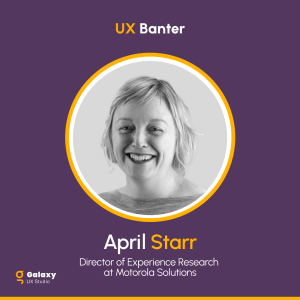
S2 Episode 1 - UX for All – Making Design a Public Utility - April Starr
April Starr, the Director of Experience Research at Motorola Solutions, is creating an impact on public safety with her insight-driven designs. A faculty at the Illinois Institute of Technology's Institute of Design, April has developed cancerworksheets.com to help cancer patients deal with their medical conditions. An altruist at heart, April is a problem-solver who loves to take complex challenges to come up with exciting and efficient design solutions.
Discussion Points
How did you become a designer, and what were the choices that you made? 01:25
What does the role of a day-to-day researcher look like? 04:45
Rapid fire questions 12:54
About the website that you created about the cancer care cards: how do those worksheets come to be? And what was the thought behind creating that website? 18:04
Do you want to give any suggestions to those starting off in the UX industry or something that you wish you knew before you started your journey as a UX professional? 23:56
So you also said that you are still looking for people to hire? 26:07
Show Notes
I didn't really realize that I loved problem-solving until I got into design. 02:05
In the beginning, I just loved really hard problems. And then I think that's sort of evolved over time to systemic problems that really impact society in some way. 02:49
We work on great problems trying to utilize AI to help support our users, we always believe in keeping humans in the loop. 07:06
We always want to assist people so that we can help them make the best decisions in those really critical moments in these really tough incidents that they work in. And help them with mental health as well. 07:22
I had time to reflect on our experience, um, I was just really angry and frustrated with the healthcare system, for many reasons. As I reflected on our experience, you know, I looked back and I was like, what a messed up experience. It occurred to me that we didn't get the right information at the beginning of the experience. 19:19
I thought, Hey, you don't know how you're gonna get there. But you know what, you want to go, you want to get rid of cancer. And you know, generally kind of the steps that you're going to need to get there, you're, there's a treatment plan, there's going to be some milestones of diagnostic tests. 20:35
Find a place where the people are supportive, and they're people that are going to inspire you, you know, find a place where the content itself is going to be something that is exciting for you. 25:03
We have a number of people, and a number of positions open on both the research team and the UX design team. On the UX design side, we're looking for UX designers and UI visual design. And so, you know, we have positions open globally. 26:10
Contact
LinkedIn: https://www.linkedin.com/in/aprilstarr/
Portfolio: https://about.me/aprilstarr
Instagram: https://www.instagram.com/aprilstarr/
#userexperience #uxdesign #uxresearch #userexperiencejourney #uxbseason2 #uxbanter #uiux
Thursday Jun 16, 2022
Thursday Jun 16, 2022
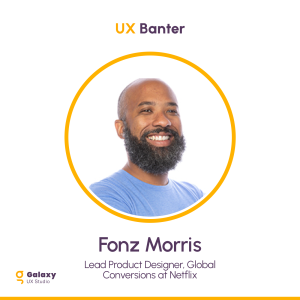
Season 1 - Ep. 8 - Growth Design: A holistic approach to Product Design - Fonz Morris.
Fonz Morris, the Lead Product Designer at Netflix, is enthusiastic about designing engaging, inspiring, and attractive experiences for people. He has worked with some of the most well-known companies in the world, including Coursera, Comcast, ESPN, and High 5 Games. He is a mentor, a DEI Advocate, a speaker, an advisor, an entrepreneur, and a self-taught designer.
Discussion Points:
Being a self-taught designer, what inspires you about designing? And, any tips for the people who are learning to design on their own? 1:09
Netflix is one of the most popular entertainment platforms in the world, how to create such products with immersive and inclusive user experiences? 1:52
As a Lead product designer at Netflix, and even having worked with the world’s leading brands. What have been your key learnings as a designer there? 3:36
How was your journey? How did you get into this industry in the first place? 7:37
What is Growth Design? Why is it important and what are the skills needed to be successful in Growth Design. 27:00
What is some advice that you’d like to give someone who’s just starting out in the industry? 33:13
Show notes:
It all comes down to solving user problems and developing effective-efficient solutions at the end of the day. 1:45
When you have so many consumers like at Netflix, it's not a good idea to just flip the switch and roll everything out at once. What if there are some problems? What if you want to tweak something or do something else, and you'd rather do it in phases, which I believe keeps everything safe. 3:19
Every company moves a little differently. However, they follow the same product design principles and aim at conversions. You have to think about how mature are those design agencies, their design team, how big that design team and all these little things matter to help you really well to craft each individual team. 5:54
Every time someone works for a different brand or organization, they have to absorb not only the new user base but also the culture of the company or organization that you're working for and what kind of steps they're bringing in. - Dushyant 6:17
Before you take the job, make sure that you have done some research on their culture and that there is some synergy between your values and principles and the company’s. Make sure you want to work in that industry and you've done as much research as you can to discover what it's like to work there. 7:00
Entrepreneurial advice: You really have to have a better understanding of what your investing looks like. Because it may take time for your idea to actually take off. So if you don't have enough runway, then you won't be able to stay afloat long enough to maybe have the industry understand your idea and support your idea. 10:37
For anybody who is looking to work with bigger companies and organizations, it's a stepwise process, if you can't just crack it with your placement directly, I think the best way would be to just get the relevant experience and make sure that you keep making connections, you keep meeting people, and go to these events.12:30
Learn from people's successes. But don't judge yourself based on their successes. Maybe that’s not the path for you, so find an alternative path. Keep getting experience, keep pushing and one day you’ll be where you want to be.12:58
Growth design is essentially the intersection of business and design. A lot of the work I do at Netflix is focused on the design, but also heavily focused on the business impact. Only being focused on one aspect of the design, be it UX or UI is not enough, we should think about the success of this feature overall, business metrics, and what's the business impact of that. That happens when you are data-driven and as a growth designer, I am using the data, I know where the business wants to go plus design, along with user research and user experience which is a more holistic approach. 27:09
Career advice from Fonz: Be patient with yourself and have fun. Invest in yourself. Invest in yourself, like you're the product. All the time that you put into bringing all the pieces together in your portfolio and what you think you're going to do when you get this amazing job at Meta. Make sure you put that same time into yourself so that you are on the right path. Make sure you take time to do self-assessments, make sure you take time to really think about what you're passionate about, and what success looks like for you. And try to build a little plan for yourself. It may change that's fine. It's not about following the plan. Exactly. It's about just having some form of structure and being able to build on things and over time you'll get to wherever you want to go. 33:24
Remember that you are a designer and you will get better as time goes by. But you have to take that first step. 34:30
Take your time if you fall. Get back up, get up, and keep pushing. If you fall again, just get back up and keep getting back up, no matter what happens, because it's so worth it. 35:16
Links:LinkedIn: https://www.linkedin.com/in/fonzmorris/Instagram: https://www.instagram.com/fonzmoney/?hl=enTwitter: https://twitter.com/youngfonz?lang=en

Thursday Jun 09, 2022
Thursday Jun 09, 2022
Season 1 - Ep. 7 - Importance of Authenticity in Branding - Neal Foard
On this episode of UX Banter, we chat with Neal Foard who is the Chief Marketing Officer at Within Inc. He is an eloquent storyteller, a TED Talk Speaker, a creative thinker, and a strategic marketer.Discussion Points:
What makes a good brand? 1:26
What has been your key learning while working with big names like Toyota, Sony, HSBC, Heineken, etc.? 5:10
Rapid Fire Segment. 13:44
What is some advice that you’d like to give someone who’s just starting out in the industry? 27:02
What is your success mantra? 31:59
Show notes:
“The most important thing for a brand is authenticity, that is they have to conduct themselves in the world in a way that people will be satisfied with.” - Neal Foard 1:38
It isn't enough to simply create a public persona, because it's quite easy for people to discover how false that might be. 2:17
The focus should not so much be on the marketing and brand messaging, it's really about what the brand is from an experience standpoint. 2:36
When the people that represent the brand are enthusiastic about it, when they believe in it, or they believe in the leadership, that gets reflected out into the world. 3:18
In marketing it's not really the cleverness of the message, it's the sincerity of it. 8:53
You can work, you can find work. And when you can, it can be well-paid work. But unless you are working for someone you admire, I don't know that you're ever going to really learn what you need to learn. 27:21
Life advice from Neal: Our accents are simply the result of us imitating the people that we learn from. We've adopted their manner of speech. And we do that with everything. We mimic their body language, we mimic their gestures, and we mimic their postures. But most of all, we mimic their behavior without realizing that's an accent and to work for a great person, to find someone you admire. Maybe take a little less money to work for something you admire. The dividend will be paid back to you not in money, but in becoming a great person like them. 28:59
Links:LinkedIn: https://www.linkedin.com/in/neal-foard-3727403/
Thursday Jun 02, 2022
Thursday Jun 02, 2022
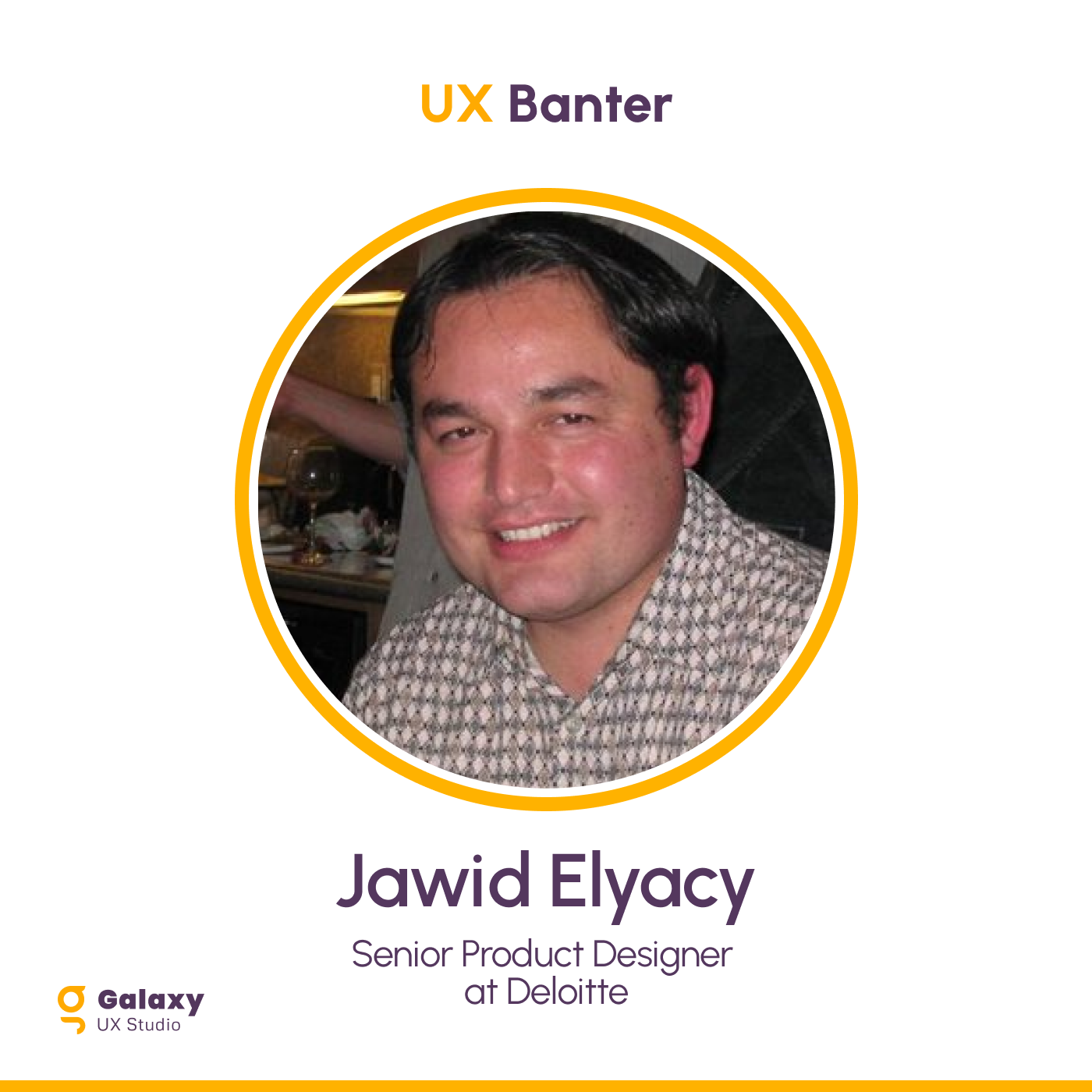
Season 1 - Ep. 6 - The Right Approach to UX Designing- Jawid Elyacy
Jawid Elyacy is a Senior Product Designer at Deloitte and has worked with some of the world’s most beloved brands such as Cisco, Mercedes-Benz, Bank of America and many more. He has over 10 years of experience in domains like automotive, IT, enterprise, web, banking, etc., as a UX designer.
Discussion Points:
What is your story of becoming a creative professional? 1:08
You have worked with TCS, Cognizant, U.S. Bank even now as a UX architect lead at Albertsons Companies, what have been your key learnings, what did you learn as a designer? 4:59
How was your experience in the telecom industry? 8:39
Where do you get your creative inspiration from? 22:54
Show notes:
Nowadays, UX has morphed into something more, it is about being a hybrid designer now. So you're not just someone who just did interaction design or wireframes, or, you know, user journeys, things like that. You're more of somebody who does kind of the whole package for the end-to-end user experience. 4:20
Once you identify a problem, maybe a user issue or something like that, then you build upon that. You kind of use that as a requirement and then build a project around that. 9:21
From a UX standpoint, you should always speak up and champion the cause of UX. If you feel like a particular flow or something is lacking from a UX standpoint or didn't take into account the customer's behavior, then it's going to be a bad experience for them. At such moments, you have to really speak up and let them know the UX inefficiencies 11:02
If you don't follow your inclinations then the end product might suffer.12:10
User advocacy is a part of the job, if we are not doing it, then we are actually missing out on what we are hired to do. - Dushyant 12:33
Design is not an easy to learn field, because it's not like engineering or civil engineering where you can read a book and become proficient at it, you follow ABCD, it's a very learned field, you kind of learn from experience. 23:30
Design is a double-edged sword; you gain it from experience. 24:07
Design is all about the approach in the early stage to get it right. And then later, the actual design is easy, it is like creating it in whatever tool you use. The research part and the user discovery phase is the really important critical part followed by deciding on the buttons and colors etc. 24:47
It's okay to make mistakes, because you will make mistakes when you are designing something. Jawid 26:49
Links:LinkedIn: https://www.linkedin.com/in/jawid-elyacy-10355b1/
Twitter: https://mobile.twitter.com/jelyacy?lang=ca
Website/Portfolio: http://www.jawidelyacy.com/about-me.html
Thursday May 26, 2022
Thursday May 26, 2022
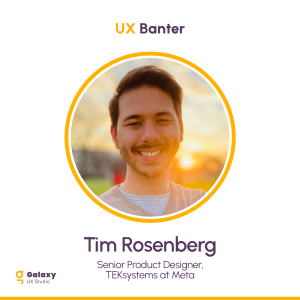
Season 1 - Ep. 5 - UX for Web 3.0 and the Metaverse- Tim Rosenberg
Tim Rosenberg is the Senior Product Designer | TEKsystems at Meta. Tim believes that with collaboration and vision, extraordinary things can be accomplished. He is a creative designer, technical developer, and also a mentor for the creative community. His specialties include, Product Design, UX&UI Design, Frontend Development, HTML5, CSS3, and SASS.
Discussion Points:
As a designer at FAANG / MAANG corporation - what's the view like from the top? 1:10
From the UX product designer point of view, how are the things kept so that they are seamless? 3:28
From the UX point of view, do you think that a future like this is the direction that the industry is heading in? 6:06
Do you think the current UX skill set can be incorporated to build and design everything for the metaverse? 8:49
What is your take on AR and VR? 10:26
How long do you think that AR and VR will take to become a household reality? 13:05
What are your metrics of designing products that bring the light to the users? 26:33
What are the things that you wish that somebody would have told you, when you were starting out? 33:30
Show notes:
One of the biggest things that I've learned about working on a product, like the Facebook app, is that there are no more edge cases. You can't just think like, oh, well, we're gonna ignore this, because, it's such a small percentage, that percentage, even if it's small, it could be like a millions of people at scale. 2:04
One of the most important things and the hardest things is prioritization in UX design. 4:13
To reduce cognitive load, you must know what's the most important thing? Sometimes these executives just say everything's important. But if everything's important, then really, nothing's important. 5:37
I think VR is the future of how we interact and experience. But, I also think that it's going to be a bridge to help facilitate real life in person engagement as well. 7:39
AR will be more like a real world imitation. And then VR will be like, almost like a separate world immersion. 11:23
When you build empathy with the users, you'll find a lot more product success, because you're not building features for the sake of being flashy or for getting more advertisement and ROI. You're building features for empathy. 27:30
This is the feeling that I get whenever I think about blockchain. Blockchain is an amazing solution. But I don't think that we have yet run into the problem that it could solve. - Dushyant 28:36
I have three buckets of advice. So the first bucket is on craft. The second bucket is on building a portfolio. And then the third is identifying opportunities. 33:55
Being part of communities like on LinkedIn or ADPList, when you build relationships with people, then when there is an opportunity, oftentimes you'll learn about it before there's even a job post. 39:58
Don't reinvent the wheel. This statement is true on so many levels that if you are a designer, if you can just go through the Google Design guidelines, the material design application out there, if you can just read the human guidelines created by Apple, that will help you. - Dushyant 41:01
Links:Tim Rosenberg Linkedin: https://www.linkedin.com/in/tim-rosenberg/
Adp List: https://adplist.org/mentors/tim-rosenberg
YouTube: https://www.youtube.com/channel/UCguyETGxbtYT-gR6j4lA-qA

Thursday May 19, 2022
Thursday May 19, 2022
Season 1 - Ep 4 - A Designer's Guide to Working in Tech- Alp TurgutIn this episode, our host Dushyant Kanungo sat down with our guest Alp Turgut, UX/UI Design Lead & Creative Director of ArtX Design Studio. He has vast experience in the field and has worked with well-known companies like Nike, Atlassian, Rolls-Royce, Salesforce, O2, Zalando, and many more. He is a speaker, mentor, consultant, and an award-winning creative freelancer.Discussion Points:
Can you share your journey of becoming a designer with us? What inspires you the most about UX & UI designing? 1:26
Coming from a technical background of computer sciences, how do you leverage your technical skills in product designing? What technical skills should people who are not from a technical background learn? 3:51
Can you tell us about any specific technical skill that you would recommend that the non-technical people in the design community should ideally learn or know about? 4:55
Since you’ve worked with some of the best brands covering a wide range of domains, what have been your key learnings from those projects? 7:34
Rapid Fire Segment : 12:19
Since you speak about having deep compassion for users you are designing for, can you tell us some practical ways of developing empathy or connecting with the users? 21:05
Can you tell us about your minimal content approach? How do you strike a balance between designing simple and minimal interfaces yet providing all the necessary information to the users? 23:01
What is some advice that you’d like to give someone who’s just starting out in the industry? 25:09
Show notes:
As a UX UI designer, you are actually seeing the problem as a kind of opportunity to solve and create a better experience for the people who's going to be using that solution. 02:54
In terms of feasibility, talking in their language is helping me to create a bridge between the stakeholders and the development team and to create the best design that can be possible for all people to be happy at the end. 4:36
You don’t need a development background at all, to be one of the best UX UI designers. 5:06
If you want to be a master of something, I believe, the focus should be on that all the time. 5:20
In order to be a very good designer, you have to use your time from a design perspective, rather than coding. 6:30
You have to think carefully from a user perspective, because you are technically the first user at hand. You need to think if the design looks good and works well for you. You also have to do your research carefully with the competence of user research and market research. 21:47
You have to define the main problem in order to come up with the optimum solution, the problem that you want to solve might not be the priority, it is good to solve all the problems, but it is best to solve the main problem first. 22:21
If you are thinking the same thing that you did 10 years ago, you haven't lived it yet. Because you're changing, everything's changing, your ideas are changing too. 25:43
If you're starting your career as a UX designer, the first thing to keep in mind is to know the principles of UX, second is to know the industry, and third is to maintain a portfolio. 26:10
Links:LinkedIn: https://www.linkedin.com/in/alpturgut/Website: https://www.alpturgut.com/
Adp List: https://www.adplist.org/mentors/alp-turgut
Thursday May 12, 2022
Thursday May 12, 2022
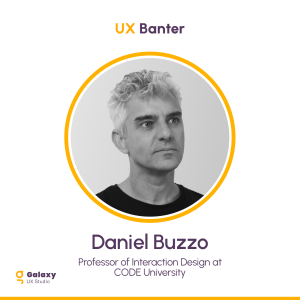
Season 1 - Ep. 3 - The Actual Interaction Design is Underneath!
Daniel Buzzo is the professor of Interaction Design at CODE University, Berlin. Interestingly enough, Daniel makes art with machines. From writing books, blogs, films, filmography, photography, design research to sculpture art, he is a master of all with a dynamic personality.Discussion Points:
What is the importance of interaction design in designing experiences for people using technology? 4:24
You talk about different kinds of design like generative, participatory, critical, speculative. Can you share some real-life examples of such designs? 13:21
Rapid fire segment 17:55
How important is the understanding of Human Computer Interaction in designing product experiences? 24:07
Would you like to shine more light on research through design? 25:32
Can you tell me about making art with machines? 29:15
Shownotes:
The things that sustain our lives, about being with family, about communicating with other people about living our lives. A lot of it is supported by technology that we design.03:08
And it is still the young designers, engineers, scientists, artists, visionaries, who will see new ways of putting these things together, and maybe conceive of new ways to apply technologies to different problems or all problems. 3:48
We didn't get where we are today by design, we got here by stumbling and trying things out. And occasionally people would get lucky and everybody would say, Oh, they're a genius! 04:10
People that are not within the field of interaction design, only see the surface, and they think everything exists on the surface. 05:20
That's an interesting perspective to think about user experience. That it relates to something very, very human, rather than it being about the color of the icons. 09:18
People will take what you think you've designed, and use it always in different ways and feel different things about it, no matter what you do. 12:00
As digital designers, when we design things for people to solve a particular need or problem today, that noodle problem may change tomorrow, that people may change. 27:27
Design is a generative process, which is why we ideate, we can analyze problems, we can work in participatory design with the people that would use the things that we might make. 27:50
Links:LinkedIn: https://www.linkedin.com/in/daniel-buzzo-751b99/
Website: https://buzzo.com/

Thursday May 05, 2022
Thursday May 05, 2022
Season 1 - Ep. 2 - A Holistic Experience - Beyond UX and CX
Fergus Roche, Design Director at Valtech is our guest today. Fergus strives to lead change with user-centric design. He is a master of many domains helping organizations to research, innovate, and enable a digital transformation through user-centered design. An excellent problem solver and a critical thinker.
Discussion Points:
How do you think user-centered design can bring about a change? What kind of problems can we solve with user-centered designing? - 3:19
Can you tell us a bit about “Matrix leadership”? How is it useful in organizational UX? - 6:16
What have been your key learnings while designing CX for the big names like Johnson & Johnson, Qatar Airways, BBC, Vodafone, Cisco, HP, Toyota etc. - 13:28
Rapid fire segment - 20:00
As you are a psychology graduate, how do you leverage the understanding of human psychology in user research? - 26:36
Being a part of both larger setup and of smaller agency, when you're working or dealing directly with the clients and the problems. What is the difference between the two experiences? - 29:23
Show notes:
It's really about testing our assumptions, like our design assumptions with real humans so that people can make better decisions. 3:45
Not the technology, not the system, not the business, but the user and that really holds weight for me. 4:27
The value of user-centered design is trying to understand what the risk is and what the opportunity is and what the uncertainty is. 5:17
Matrix leadership is about finding that win-win in the relationships and the consensus that you're trying to build. 6:57
The difficulty with transformation just comes down to a bunch of humans that work together, and they want to do things differently. 11:11
Testing our assumptions and removing the risk is inherent in the design process. 3:48
UX is just one discipline where you’re actually designing for a real experience that real humans are going to have with a product or service, there's so many different kinds of parts of an organization and disciplines that need to be involved with that, you really got to start looking at the total experience. 16:10
How you measure success for somebody's when wireframing stuff out, during the design and build process versus, when an actual live product, is quite different. 17:01
There's a space that we need to get to where we get beyond UX, we get beyond CX, and we actually start to get more holistically joined up around the total experience. 17:16
My favorite holiday destination is somewhere where it's hot and I'm with family or friends or both. 20:15
I'm gonna mention Uber. Okay? It is by far one of the best customer experience focused propositions of a business. 25:18
We all get together, and get the best and learn from each other, while kind of simplifying our decision making, so that we can scale. 33:21
Links:LinkedIn: https://www.linkedin.com/in/fergusroche/

Thursday Apr 28, 2022
Thursday Apr 28, 2022
Season 1 - Ep. 1 - Design is about Understanding Different Complexities
Felix Lee is our very first guest on the UX Banter Podcast. Felix is the Co Founder at ADPList having a vision to inspire powerful conversations and collaborations among members of the design community.
Felix is an engineer, an ex-army man, a design lead and an entrepreneur who believes in constantly reinventing the way we experience the world. Discussion Points:
What’s the story behind starting ADPList? 1:38
From joining the army to starting a successful startup, what has your journey been like? 5:00
Have you had any mentors in your life? And how has their impact been in your career? 9:00
Are there any happy surprises along the way? 12:30
Rapid Fire Segment 17:29
It's commendable that you have an inclusive team at ADPList with 60% female and 40% people of color. Any tips on building diversified teams at work? 29:17
Show Notes:
ADPList is on a mission to democratize mentorship, and to bring mentorship, access to the world, with over 6000 mentors from 90 different countries.
Design is much more about understanding many different complexities, as compared to just trying to design an app or something.
A lot of designers don't like working with data, but the best designers spend 70 to 80% of their time on data.
I just want to do amazing things, I just want to be able to do some amazing work for the world.
I only had one very focused goal that I wanted to be the best designer that I could be in these two years.
One of the surprises that came along my way was truly how fundamentally good the majority of human beings can be.
ADP wouldn't be here today, without the earliest people who had believed in us and wanted to continue to help us and some of them, do it on a voluntary basis.
I think the fallacy of UX is that people tend to think that it solves a problem through good experience and usability.
We have a lot of people who can do the work, but not a lot of people who can think and it's a rare commodity these days.
Links:LinkedIn: https://www.linkedin.com/in/felixleezd/Website: https://adplist.org/

A fun and conversational podcast where the design industry experts share their story, learnings, and the processes they follow to create successful digital products and user experiences.